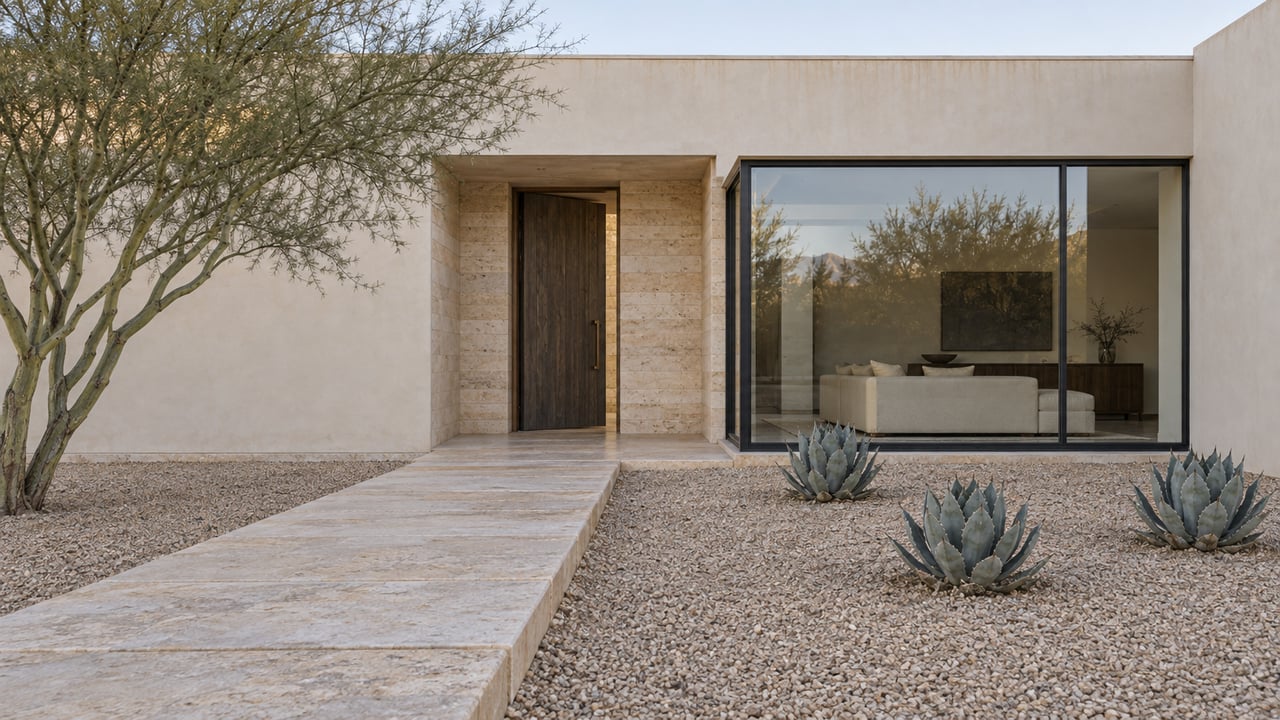
Greater Phoenix Tipped Toward Buyers. Which Scottsdale Market Are You Shopping In?
October 29, 2026
October 29, 2026
If the whole Valley has become a buyer's market, why does a $2 million Scottsdale house still sell like it's 2021?
On October 21, 2026, the Cromford Report reported that its Market Index for Greater Phoenix, covering all areas and all dwelling types, had dropped to 69.9. It hadn't been below 70 since March 12, 2009. Cromford reads anything under 90 as favoring buyers. By October 24 the index on Cromford's homepage had slipped further to 69.0, with supply at 107.5 and demand at 74.2.
A buyer moving to Scottsdale could fairly conclude the leverage has shifted their way. That's true for some homes in Scottsdale and much less true for others. Across the city, the advantage depends on which segment you're shopping, and the numbers that look most reassuring to a buyer can be the easiest to misread.
The Cromford Market Index is a short-term reading of balance. It tracks pending, active and sold listings and compares them with the previous four years. The 69.9 figure combines a $400,000 resale in the West Valley, a condo in Tempe and a hillside estate in north Scottsdale. When demand drops in the segments that make up most of the Valley's sales volume, the metro reading falls even if one tier is still competitive.
Scottsdale's own data shows it doesn't line up with the Valley-wide signal. On Cromford's October 23, 2026 rankings, Scottsdale's annual median price for detached homes was $463.75 per square foot, up 2.7% from $451.61 a year earlier, and the trend is labeled "up, favors sellers." That ranking measures price appreciation, not the balance between buyers and sellers. Still, it's hard to square with a city where buyers have taken control.
The Scottsdale Independent reported this month, citing Phoenix REALTORS Board President Sammy Glassman, that Scottsdale has three separate markets heading in different directions. Year to date in 2026, the single-family median price is up 5.5% to $1.25 million and the townhome and condominium median is down 1% to $495,000.
The luxury tier splits along the same line. In the Institute for Luxury Home Marketing's October 2026 report, which covers September 2026, Scottsdale's luxury single-family and luxury attached homes come out on different sides of the market-type scale.
| Scottsdale segment, September 2026 | Median list price | Median sold price | Days on market | Sales ratio | Market type |
|---|---|---|---|---|---|
| Luxury single-family | $2,299,955 | $1,699,000 | 66 | 24.0% | Seller's |
| Luxury attached | $920,500 | $825,000 | 88 | 15.4% | Balanced |
The Institute uses its sales ratio to measure market speed. Below 12% is a buyer's market, 12% up to 21% is balanced, and 21% or above is a seller's market. At 24.0%, Scottsdale's luxury single-family homes sat above the seller's-market line in the same month the metro index was falling toward its 2009 low. Luxury attached homes, the condos and townhomes, took 22 more days to sell and landed in balanced territory.
Don't read the gap between median list and median sold in that table as a discount. The list median describes homes still for sale, and the sold median describes the homes that actually closed, so the two figures cover different groups of houses. That gap tells you more about which homes are selling than about how much any one seller gave up.
This is where buyers coming from other markets often misjudge their leverage.
According to Scottsdale REALTORS' September 2026 market report, homes across the city sold for 97% of list price that month. A 3% average discount sounds like little room to negotiate. But a ratio is only as informative as the list price it's measured against. Cromford's definitions state that its sale-to-list measure uses the final list price at closing, which can differ from the original asking price. A home that came on at one price, was reduced twice and then sold close to its last price can report a ratio that looks barely negotiated.
The statewide data shows how often that happens. ARMLS's August 2026 STAT report found that 75% of July's single-family closings sold below their original list price, 14% sold at list and 12% sold above it. Above-list sales were concentrated in lower-priced markets.
For a Scottsdale buyer, the listing history is the useful number, not the summary ratio. Look at how long the home has been listed and how far the current price is from the first one. Both tell you more about the seller's position than any citywide average.
Scottsdale's own trend over the summer explains why the city hasn't followed the metro index straight down. It also suggests that could change. The Scottsdale REALTORS monthly reports combine single-family homes with condos, townhomes and apartments, so they measure the city as a whole and not any single segment.
| Scottsdale, all dwelling types | June 2026 | July 2026 | August 2026 | September 2026 |
|---|---|---|---|---|
| Months of inventory | 4.51 | 4.16 | 4.02 | 4.57 |
| Sold-to-list | 96.5% | 96.4% | 96.3% | 97% |
| Median sold price | $992,500 | $900,000 | $882,500 | $950,000 |
| New listings | 634 | 570 | 745 | 925 |
| Active listings, month-end | 2,487 | 2,216 | 2,185 | 2,373 |
From June through August, supply got tighter, which helped Scottsdale hold firm while the wider Valley softened. Then September brought 925 new listings, up from 745 in August, with a median list price of $1,095,000, up 15.9% from the month before. Month-end active listings rose to 2,373, and months of inventory climbed to 4.57. Median days in RPR rose to 75.
That new supply also skewed expensive. When the median price of new listings jumps almost 16% in a month, it suggests more of them came in at the upper end, the same tier where the luxury data still showed a seller's market. Whether that tier stays tight through the winter depends on whether buyers absorb this inventory as fast as they absorbed the thinner supply of the summer. The September data doesn't answer that yet. The October report will be the first real test.
Part of the reason the luxury single-family tier has held up is that its buyer pool has been growing. The Phoenix Business Journal reported on October 11 that north Scottsdale luxury home sales rose 24% over the past year, with land values rising and a deeper pool of high-dollar buyers adding to competition.
Pricing at the top reflects that confidence. The Phoenix Business Journal also reported this month that a 6,282-square-foot estate at the highest level of Silverleaf was coming to market at $10.5 million, with its furnishings and an adjacent vacant lot included. The very top of the market has also been inconsistent. In July, azcentral covered a Silverleaf mansion once listed at almost $22 million that went to auction, where bidding opened at $8.01 million. So even the strongest segment gives some properties a long route to a sale.
The metro index tells you the direction of the overall market. To judge your own leverage in Scottsdale, look at the segment you're actually shopping:
Is Scottsdale a buyer's market now? The Valley as a whole is, according to the Cromford Market Index reading of 69.9 on October 21, 2026. Within Scottsdale, the September 2026 luxury data classified single-family homes as a seller's market and attached homes as balanced, so the answer depends on what you're buying.
Why did Scottsdale's sold-to-list ratio rise while the Valley softened? Scottsdale's ratio for all dwelling types rose from 96.3% in August to 97% in September 2026. Supply tightened over the summer, and depending on how a ratio is calculated, it may be measured against a final list price that already reflects reductions.
When will the next Scottsdale numbers be available? Scottsdale REALTORS published its September report in early October, so the October figures should follow on a similar schedule in early November. That will be the first month to show whether September's listing wave was absorbed.
If you're comparing a north Scottsdale single-family home with a luxury condo, or deciding how hard to negotiate on a listing that has already had price cuts, John Zook can walk through the segment data and the listing history with you before you make an offer. Let's Connect.
Experience a real estate partnership built on trust, expertise, and genuine care. John brings a lifelong understanding of what “home” truly means to every client and every decision.