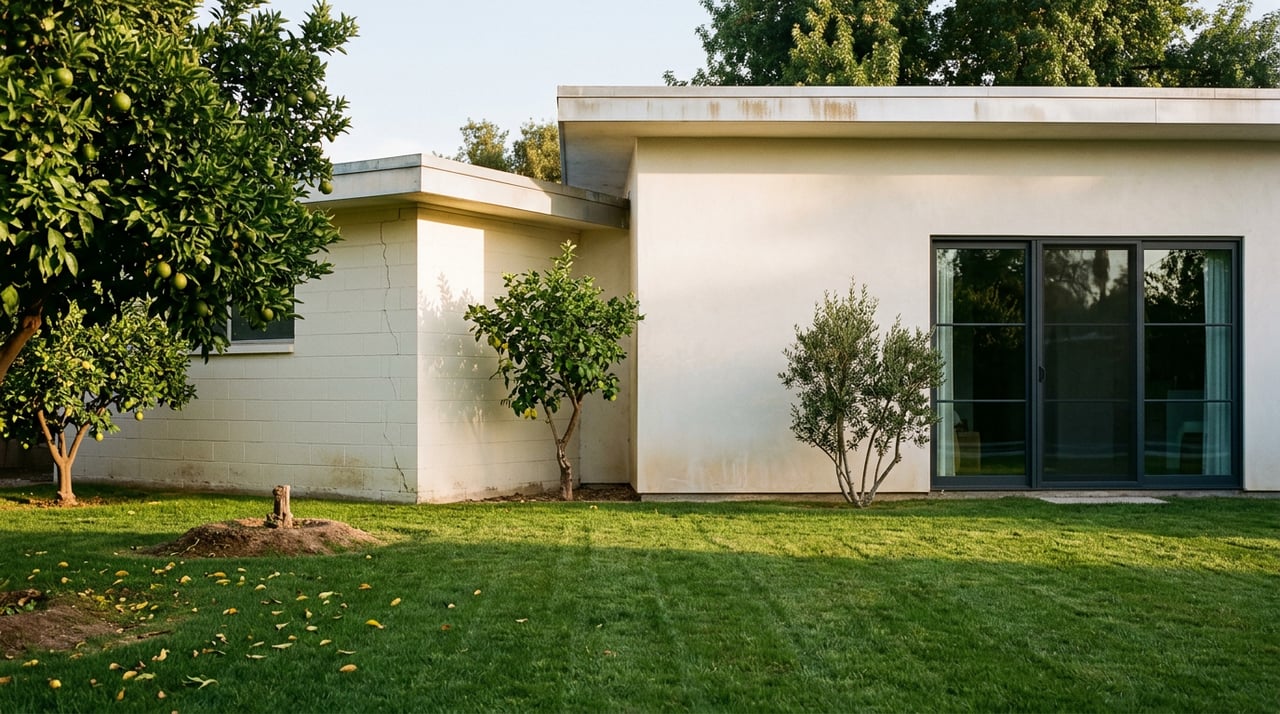
What Arcadia Phoenix Teardown Lot Value Really Means
August 20, 2026
August 20, 2026
Ask an Arcadia listing agent what a buyer is purchasing at $1.5 million and most will start talking about square footage, finish level, maybe the school assignment. Ask a builder the same question and you'll get a different answer entirely: the dirt. In Arcadia, the price on the sign has less to do with what's standing on the lot than with the lot itself, and once you see the pattern in the data, you can't unsee it in the listings.
That distinction matters most at the one boundary no map agrees on. Arcadia Proper and Arcadia Lite are informal names, not zoning designations, but the City of Phoenix historic survey places the Proper core between 44th Street and Scottsdale Road, south of Camelback Mountain and north of the Arizona Canal. West of 44th Street, lots shrink and the label softens into "Arcadia adjacent." Cross that line and the same tree canopy, the same citrus-era irrigation, and often the same builder can produce a home worth a fraction of its Proper-side counterpart. If you're comparing two listings and the only thing separating them is a street number, you're not comparing product. You're comparing land classifications that happen to look similar in photos.
The boundary isn't accidental. Arcadia Proper traces back to a 1919 plat that carved the old citrus groves into five- to ten-acre parcels and required a minimum construction cost, a deliberate filter meant to keep the area exclusive from the start. That platting decision is still doing work more than a century later. Quarter-acre to half-acre lots remain common in Proper, while blocks just west of 44th Street run closer to 10,000 square feet. The neighborhood's identity, the leafy streets, the flood-irrigated lawns, the sense of privacy, was engineered into the lot sizes before a single mid-century ranch was ever built on top of them.
That history explains something buyers often get backward. They shop for a house and treat the lot as a feature of it. In Arcadia, the relationship runs the other way. The lot is the asset, and the house is closer to a variable that gets negotiated, renovated, or removed entirely depending on its condition.
Look at how Arcadia closes, not just at what it closes for. Cash purchases made up roughly 34 percent of Arcadia transactions in the June 2026 closing data, nearly double the citywide Phoenix rate of about 18 percent. Above $3 million, cash buyers accounted for more than half of all closings. That split isn't a preference for avoiding a mortgage. It's a signal about what's being bought. A buyer financing a home underwrites the structure: condition, systems, comparable sales. A buyer paying cash for a teardown-ready lot is underwriting the land, and land doesn't require an appraiser to agree with a lender's risk model before a deal can close quickly and quietly.
The same June 2026 dataset put Arcadia's ZIP 85018 median sale price at $1,545,000, up 1.8 percent year over year across 79 closings, with price per square foot averaging $618. On its own, that's just a headline number. Paired with the cash share, it reads differently: a meaningful share of that median is being set by buyers who never intended to live in the existing structure at all.
If Arcadia priced like a normal market, the least expensive segment would move fastest. It doesn't. Quartile data from Altos on the 85018 single-family market as of mid-2026 shows a pattern that breaks that assumption:
| Segment (85018 single-family) | Typical price | Median days on market |
|---|---|---|
| Top quartile | around $4.995 million | 77 days |
| Upper quartile | around $2.4875 million | 45 days |
| Lower quartile | around $1.6198 million | 49 days |
The upper quartile, priced well above the lower quartile, still sells faster. That's the opposite of what a simple affordability story would predict. What it suggests instead is that buyers aren't shopping by price tier. They're shopping by product state. A turnkey, already-renovated home in the $2.5 million range moves quickly because it requires no decision beyond closing. A $1.6 million original-condition ranch sits longer because it comes with an unspoken second question attached to every offer: renovate, or tear down and start over. Renovated Arcadia homes commonly trade within about 2 percent of list price in under 45 days, while teardown-bound properties give up 6 to 14 percent off original ask after one or two price adjustments. The discount isn't a sign the market is softening. It's the cost of uncertainty about what the next owner intends to build.
As Homes.com reported, one transaction from earlier this year makes the mechanism concrete. A newly built estate on East Exeter Boulevard, a 10,471-square-foot spec home built by Norton Luxury Homes on a rare one-acre lot in Arcadia, sold for $11 million in February 2026, a record for a speculative build in the neighborhood. One-acre parcels are unusual enough in Arcadia that the broker who represented the seller called them "almost unicorns" for development purposes. The land itself had traded once before, in May 2023, for $2.4 million, while it still carried a 1970s-era home. The builder acquired it in 2024, removed the existing structure, and built new.
Run the arithmetic and the lesson is plain. Roughly $8.6 million in value was added between a $2.4 million lot sale and an $11 million finished sale, on a property where the original house was demolished rather than incorporated into the final product. The land didn't get more valuable because of what was built on it. It was valuable enough at the outset to justify tearing down what was already there and starting fresh, which is precisely the logic that plays out at smaller scale across every Arcadia block where an original ranch sits next to a new build that dwarfs it in price.
Buying the dirt comes with its own maintenance profile, and it's cheaper in dollars than most newcomers expect but more demanding in attention. Most of Arcadia's original citrus-era lots carry flood irrigation rights through Salt River Project, and the annual cost for a typical irrigated third-acre-or-larger lot runs somewhere between $270 and $450 a year, billed in two installments. That's the full cost of the water that keeps the mature trees and green lawns alive through a Phoenix summer, and it's a fraction of what a comparable irrigated lot would cost on treated municipal water. The tradeoff is scheduling: someone has to open the turnout on the assigned day, and missing it can mean waiting weeks for the next rotation.
Arcadia is also largely free of homeowners associations, which buyers coming from planned communities tend to treat as a selling point without reading the fine print. No HOA doesn't mean no rules. Much of the neighborhood operates under deed restrictions tied to the original 1919 platting. There's no monthly dues and no architectural committee to petition for an exception, which means the protections that preserve Arcadia's character are baked into the deed rather than enforced by a board. Read the specific restrictions on any parcel you're evaluating before assuming what you can and can't build.
If a teardown is part of your plan, budget the calendar accordingly. A full teardown and custom rebuild in Arcadia typically runs 12 to 30 months from purchase to occupancy, depending on design complexity and the permitting path, which differs depending on whether the parcel sits inside Phoenix or Scottsdale city limits.
None of this argues against Arcadia. It argues for shopping it correctly. Two homes at the same price point in Arcadia Proper are not interchangeable if one sits on a legacy irrigated half-acre and the other sits on a smaller infill parcel that happens to carry the same square footage. A renovated ranch and an original-condition ranch two doors apart aren't the same asset with a cosmetic gap between them. One is priced for immediate living. The other is priced for what someone is willing to do to the lot beneath it.
The neighborhood's identity—its mature citrus canopy along streets near Postino and La Grande Orange, the walk to Camelback Mountain, and the Arcadia High School assignment—is real and it's part of what you're paying for. But when you're evaluating a specific parcel, ask less about the finish level in the listing photos and more about the lot: its size, its irrigation status, its deed restrictions, and whether the current structure is the asset or simply what's occupying the asset until someone decides otherwise.
Does an Arcadia address guarantee a specific school assignment? No. Many Arcadia addresses sit inside Scottsdale Unified School District despite carrying a Phoenix mailing address, because the district boundary doesn't track the city line. Confirm school assignment for any specific parcel directly with the district rather than relying on the neighborhood name.
How much does flood irrigation actually cost to maintain? For a typical irrigated Arcadia lot of a third of an acre or larger, annual water charges through Salt River Project run roughly $270 to $450, billed twice a year. The larger ongoing cost is usually landscaping and tree maintenance scaled to the lot size, not the irrigation itself.
If I buy an original-condition home planning to rebuild, how long should I expect the process to take? Plan for 12 to 30 months from purchase to final occupancy for a full teardown and custom build, depending on design complexity and the permitting timeline, which can vary depending on whether the parcel is inside Phoenix or Scottsdale.
If you're weighing an Arcadia purchase and want a read on what a specific lot is really pricing, land, structure, or both, John Zook can walk the parcel-level details with you before you write an offer.
This article is general information, not legal, tax or financial advice. Consult a qualified professional about your situation.
Experience a real estate partnership built on trust, expertise, and genuine care. John brings a lifelong understanding of what “home” truly means to every client and every decision.