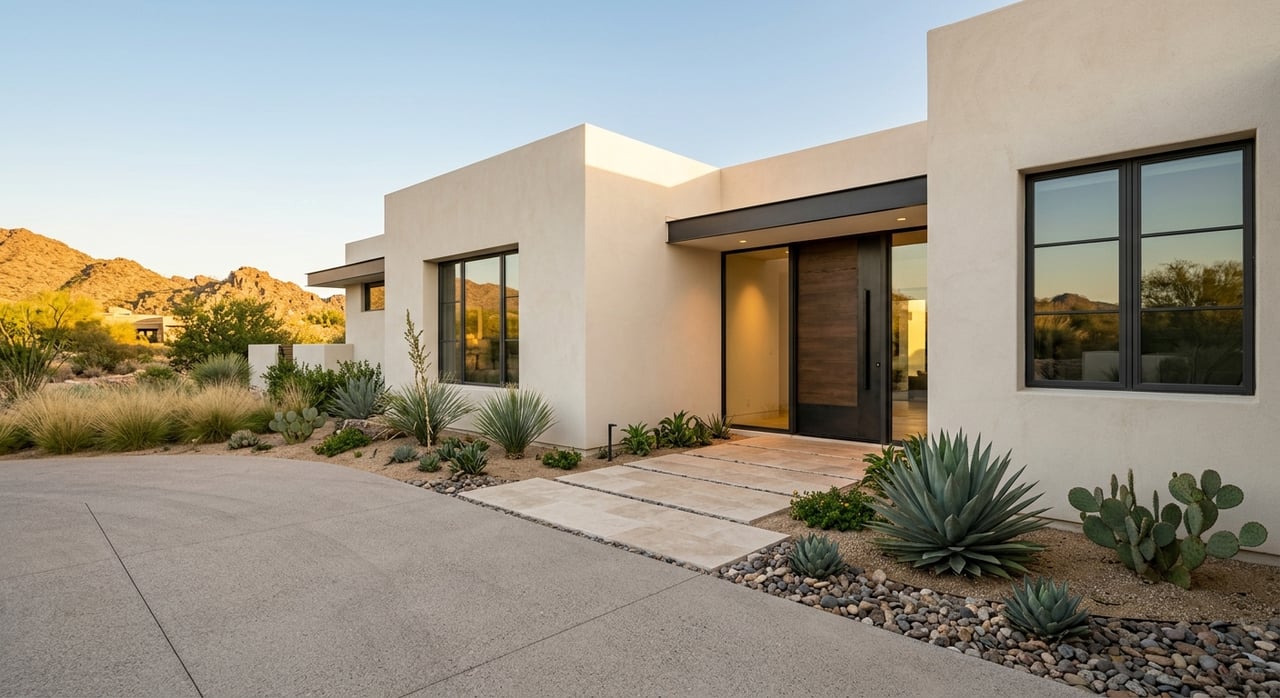
Evaluating Boutique Development Sites In Cave Creek
July 9, 2026
July 9, 2026
If you are looking at boutique development in Cave Creek, the site itself can make or break the entire project. In a market defined by open space, privacy, and a strong desert identity, success is rarely about fitting the most homes onto a parcel. It is about choosing land that supports the right product, the right price, and the right story from the start. Let’s dive in.
Cave Creek is not a volume-driven housing market. According to Census QuickFacts, the town has about 5,177 residents, 2,437 households, and a 94.6% owner-occupied housing rate, with a median owner-occupied home value of $906,100.
That matters because you are evaluating sites in a market shaped by established ownership, smaller household sizes, and long-term residents. With 41.4% of residents age 65 or older and only 9.3% under 18, the likely buyer profile leans more toward empty nesters, retirees, and affluent lifestyle buyers than entry-level demand.
A common mistake in land evaluation is focusing on acreage before buyer fit. In Cave Creek, the better question is not, “How many homes can fit here?” It is, “Who will pay a premium for this setting, and why?”
The local data suggests that buyers here are often paying for privacy, design quality, convenience, and a strong sense of place. They may also value outdoor living, open space, trail access, and in some cases horse-friendly property characteristics.
For many boutique projects, the likely buyer is not chasing density or sameness. Instead, demand appears better aligned with homes that feel intentional, quiet, and tailored to the desert setting.
That often points toward features such as:
If a site can support a detached flex space, casita, or equestrian-oriented feature, that may strengthen the product story. If it cannot, the architecture still needs to feel rooted in Cave Creek rather than generic.
The Town of Cave Creek is very clear about the character it wants to preserve. The General Plan emphasizes western and equestrian identity, open space, dark skies, scenic views, and a low-density residential pattern.
For a developer or landowner, that means entitlement and design are not separate from valuation. A site may look promising on paper, but if the proposed product conflicts with the town’s long-term vision, the path forward may become slower, more expensive, or less predictable.
The town frames site plan review around development that is functional, safe, attractive, and compatible with surrounding uses and the natural environment. That is a strong signal that product quality and site sensitivity carry real weight.
In practical terms, a parcel that supports a thoughtful, desert-sensitive plan may be more valuable than one that only offers raw square footage. Compatibility is part of the investment thesis in Cave Creek.
Not every site challenge is visible from the street. Cave Creek’s notice to prospective property owners states that some areas do not have sewer service, and many residential areas are in Desert Rural zones.
That means your site review needs to go beyond lot dimensions and views. Infrastructure, utility access, and zoning context can directly affect design options, development cost, and the ultimate buyer pool.
Before you get too far into underwriting, it helps to pressure-test a few basics:
In Cave Creek, these are not minor technical details. They can influence whether a parcel suits a small luxury project or becomes a costly mismatch.
The Town notes that horses are allowed on lots of at least two contiguous acres in Desert Rural zones. Trails are also a visible part of local life, and the town explicitly values the Sonoran Desert setting and dark night skies.
That does not mean every successful project needs an equestrian angle. It does mean the rural-desert context is part of what buyers are often responding to, so land that undermines that experience may have less boutique appeal.
When you buy a site in Cave Creek, you are also buying into a local identity. If your future homes are meant to command premium pricing, the parcel should help tell a believable story around privacy, desert character, and design authenticity.
That story can come from trail adjacency, open views, lot configuration, natural desert context, or a stronger sense of separation from more conventional suburban product. The key is that the site supports the promise.
The May 2026 Scottsdale REALTORS market report shows that Cave Creek is active, but not overly fast. The report shows 5.06 months of inventory, 52 median days in RPR, a 97.1% sold-to-list ratio, a median sold price of $810,000, a median active list price of $1.16 million, and a median new-list price of $934,750.
Those numbers point to a premium market where buyers are still paying attention to value. Pricing power exists, but it needs support from product quality, site strength, and a clear reason to choose the new offering over resale alternatives.
The spread between the median active list price and median sold price is meaningful. That does not mean the top end is weak. It means buyers are selective, and projects priced above the prevailing resale band need to earn that position.
If you are underwriting a boutique development at a premium, the site should offer something distinct. That could be better privacy, stronger views, more refined architecture, a superior layout, or a more complete lifestyle package.
One of the most useful takeaways from the local market report is that Cave Creek is not one-size-fits-all. Sold homes span multiple price bands, including 23 sales above $1.6 million, 17 between $1.4 million and $1.6 million, 13 between $1.2 million and $1.4 million, and 15 between $1 million and $1.2 million.
At the same time, the market also had meaningful sales below that range, including 27 between $800,000 and $1 million and 45 between $600,000 and $800,000. About 38% of sold comps were above $1 million, which confirms that luxury demand is real, but it is not the whole market.
The report also shows a mixed size profile. There were 58 sold comps under 2,000 square feet and 47 above 3,200 square feet.
That range suggests you should not assume a single ideal home size for every parcel. The right program depends on what the site does best and which buyer it naturally attracts.
In Cave Creek, the most compelling sites often support a small number of differentiated homes instead of a repetitive subdivision pattern. A strong boutique parcel usually makes it easier to deliver privacy, outdoor living, and architecture that feels connected to the land.
You are not just evaluating where homes can sit. You are evaluating whether the property can support a premium experience that feels native to Cave Creek.
Look closely for advantages such as:
These qualities do not guarantee success, but they often create more pricing leverage than raw unit count alone.
One of the smartest ways to evaluate a site is to imagine how the finished project will be positioned in the market. Before you break ground, you should be able to explain what site attribute is being monetized, what kind of buyer the homes serve, and why the product deserves its pricing.
In Cave Creek, clarity matters. A generic luxury message is less convincing than a specific story built around the site, the architecture, and the lifestyle the parcel can genuinely deliver.
When comparing development opportunities, it can help to ask:
If those answers are vague, the site may be harder to position than it first appears.
Cave Creek looks better suited to carefully designed small luxury projects than dense, generic subdivision-style plays. The town’s planning priorities, owner-driven market profile, and lifestyle appeal all point in that direction.
If you are evaluating boutique development sites here, the most valuable parcels are usually the ones that support thoughtful design, authentic desert character, and a clear market position. In a place like Cave Creek, better decisions start with sharper site selection.
If you are weighing a Cave Creek land or boutique development opportunity and want a strategic read on positioning, pricing, and market fit, John Zook can help you evaluate the opportunity with clarity.
Experience a real estate partnership built on trust, expertise, and genuine care. John brings a lifelong understanding of what “home” truly means to every client and every decision.